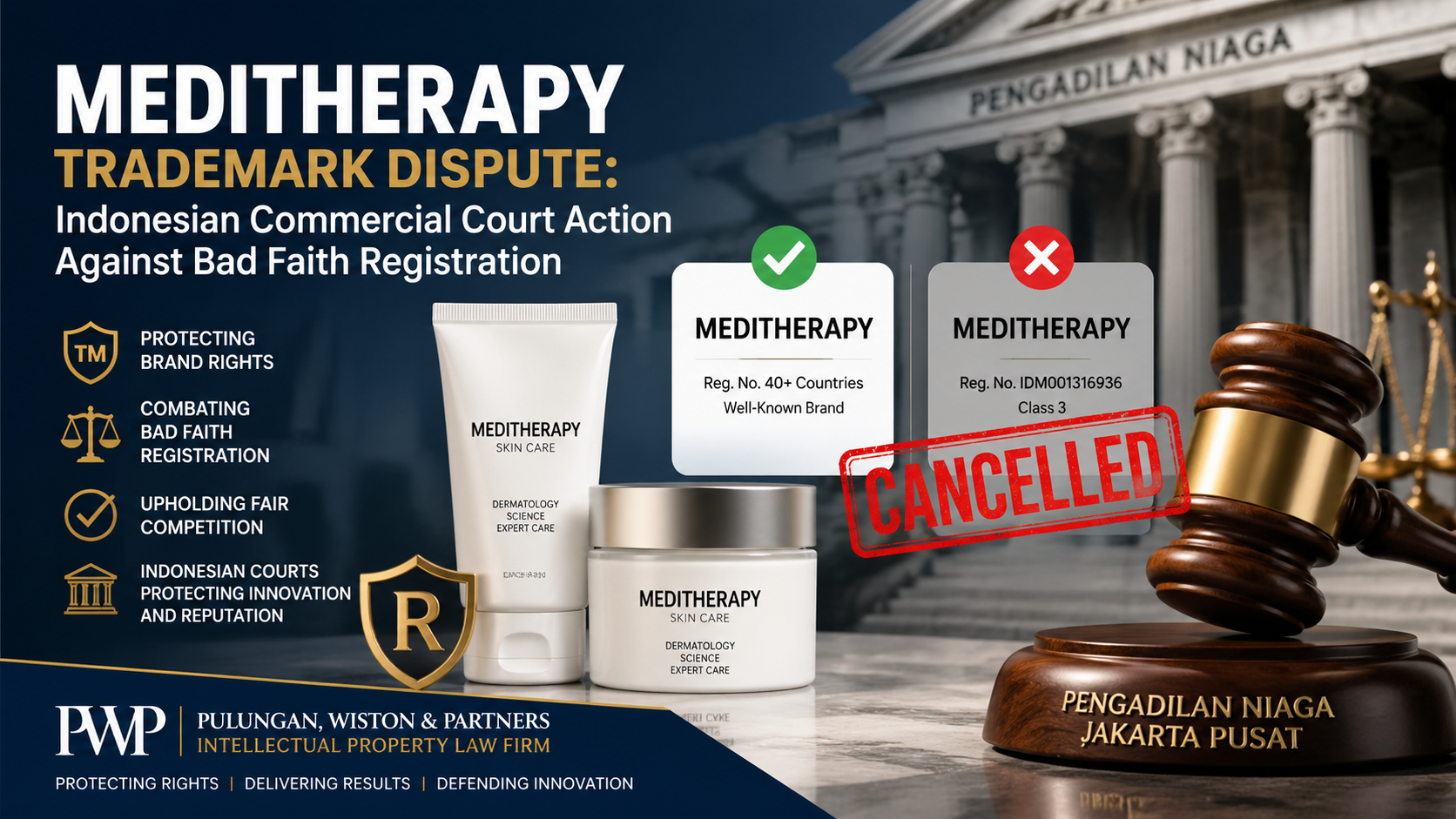
MEDITHERAPY Trademark Dispute: Indonesian Commercial Court Action Against Bad Faith Registration
The dispute concerning the MEDITHERAPY trademark highlights the growing importance of intellectual property protection in Indonesia, particularly in the cosmetics and skincare industry.
This case involves a cancellation lawsuit filed before the Commercial Court against a conflicting trademark registered under No. IDM001316936 in Class 3. The winning party in this matter is represented by lawyers from Pulungan, Wiston & Partners (PWP), demonstrating strong legal advocacy in trademark enforcement.
Parties Involved and Trademark Background
The plaintiff, Meditherapy Co., Ltd., is a South Korean company specializing in dermatology-based skincare and wellness products. Since its establishment in 2017, the MEDITHERAPY brand has gained global recognition and is registered in more than 40 jurisdictions worldwide.
The defendant, Garry Kusuma, registered an identical trademark in Indonesia covering cosmetic products under Class 3. The Directorate General of Intellectual Property (DGIP) was also named as co-defendant as the authority responsible for trademark registration.
Legal Basis for Trademark Cancellation
The lawsuit is primarily based on Law No. 20 of 2016 on Trademarks and Geographical Indications, particularly Articles 21 and 76.
Article 21 prohibits registration of marks that are similar in essence or entirety to prior registered trademarks or well-known marks. Article 76 provides legal standing for interested parties to file cancellation actions against infringing registrations.
Similarity Between MEDITHERAPY Marks
A central issue in this dispute is the substantial similarity between the plaintiff’s and defendant’s trademarks.
Visual Similarity
The marks share identical word composition, spelling, and structure, creating an indistinguishable overall appearance to consumers.
Phonetic Similarity
Both marks are pronounced identically as “MEDITHERAPY,” eliminating any distinction in verbal use in the marketplace.
Similarity of Goods
Both trademarks cover cosmetic and skincare products under Class 3, significantly increasing the likelihood of consumer confusion.
Evidence of Bad Faith Registration
The plaintiff successfully demonstrated that the defendant acted in bad faith when registering the disputed trademark.
Key indicators include the complete replication of the MEDITHERAPY name and the use of the mark in the same product category. Additionally, the defendant has a pattern of registering well-known international brands, suggesting deliberate exploitation of established reputations.
Protection of Company Name as Trademark
Another critical argument is that “MEDITHERAPY” constitutes an essential part of the plaintiff’s legal entity name, Meditherapy Co., Ltd.
Under Article 21(2)(a) of the Trademark Law, marks resembling the name of a legal entity without authorization must be rejected or cancelled. Indonesian jurisprudence has consistently upheld protection for well-known company names used as trademarks.
Commercial Court Decision
The Commercial Court ruled in favor of the plaintiff, reinforcing the principle of good faith in trademark registration.
The Court has partially granted the Plaintiff’s claims and declared that the defendant’s trademark registration was invalid due to similarity and bad faith. The Court further ordered the cancellation of Trademark No. IDM001316936 from the General Register of Trademarks.
This decisive ruling was achieved with representation from Pulungan, Wiston & Partners (PWP), underscoring the firm’s expertise in complex intellectual property litigation.
Implications for Businesses and Brand Protection
This case provides several important lessons for businesses operating in Indonesia and internationally.
First, prior trademark owners enjoy strong legal protection against later registrations that imitate or replicate their marks.
Second, Indonesian courts adopt a strict stance against bad faith filings, particularly those attempting to capitalize on established global brands.
Third, businesses must conduct thorough trademark searches and legal due diligence before filing applications to avoid costly disputes.
Finally, the decision enhances legal certainty and reinforces confidence in Indonesia’s intellectual property enforcement system.
Conclusion
The MEDITHERAPY trademark dispute demonstrates the Indonesian judiciary’s firm commitment to protecting brand owners from infringement and unfair competition.
By cancelling the conflicting trademark, the Court affirmed that bad faith registrations will not be tolerated under Indonesian law. This case stands as a strong precedent for safeguarding intellectual property rights, with successful representation by Pulungan, Wiston & Partners (PWP) playing a pivotal role in securing justice for the rightful trademark owner.