
Previously Unavailable, Now Open: UAE Trademark Filings in Class 33
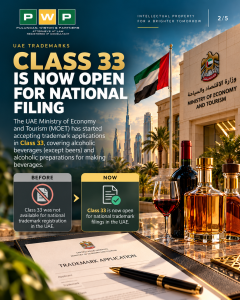
The United Arab Emirates (UAE) has opened a new opportunity for trademark owners in the alcoholic beverage sector. Since September 2026, the UAE Ministry of Economy and Tourism (MOET) has been accepting national trademark applications covering goods in Class 33, which includes alcoholic beverages other than beer. This development allows brand owners to seek direct UAE trademark protection for products that were previously excluded from national registration in this class.
For businesses with existing or planned operations in the UAE, the change creates an important reason to review trademark portfolios and reassess brand protection strategies.





What Has Changed in UAE Trademark Registration?
Previously, Class 33 was unavailable for national trademark registration in the UAE. As a result, wine producers, spirits manufacturers, liqueur brands, and other alcoholic beverage businesses could not obtain direct national trademark protection for these goods under the appropriate class.
The UAE Ministry of Economy and Tourism has now started accepting applications in Class 33, bringing local trademark filing practice more closely into line with the international Nice Classification system. The change is particularly relevant to international brand owners seeking more consistent trademark protection across multiple jurisdictions.
This is a significant development for businesses that have established their brands in other markets but have not been able to secure corresponding national trademark protection for alcoholic beverages in the UAE.
What Products Are Covered by Trademark Class 33?
Under the Nice Classification, Class 33 generally covers alcoholic beverages other than beer, as well as alcoholic preparations for making beverages.
Products commonly associated with Class 33 include:
- Wine, including still, sparkling, and fortified wines.
- Spirits, such as whisky, vodka, gin, rum, and tequila.
- Liqueurs and other qualifying alcoholic beverages.
- Other alcoholic beverage products falling within the scope of Class 33.
- Alcoholic preparations for making beverages.
Beer is classified separately under Class 32, rather than Class 33.
Correct classification is an essential part of an effective trademark filing strategy. Brand owners should ensure that their goods are accurately specified and that the selected class corresponds to the products they intend to protect. The precise specification should be reviewed against the applicable classification and UAE filing requirements.
Why Does This Matter for International Brand Owners?
The availability of UAE trademark filings in Class 33 creates several strategic considerations for businesses in the wine and spirits industry.
1. Obtain Direct Trademark Protection for Class 33 Goods
Brand owners can now seek national trademark registration in the UAE for qualifying alcoholic beverage products. This provides an opportunity to align trademark protection more closely with the goods sold or planned for sale in the market.
Direct protection for the relevant goods is an important component of a comprehensive intellectual property strategy.
2. Review Existing UAE Trademark Portfolios
Businesses that previously registered their marks in other classes should review whether their current registrations adequately reflect their commercial activities.
For example, a company may already own a UAE trademark registration for its brand in Class 32 or for hospitality-related services in Class 43. Those registrations do not automatically provide equivalent protection for alcoholic beverages in Class 33.
A portfolio review can help identify potential gaps and determine whether additional applications should be considered.
3. Support UAE Market Expansion
For wine producers, spirits manufacturers, beverage distributors, and international hospitality groups, the change creates an opportunity to reassess trademark protection in a commercially important market.
Businesses preparing to enter the UAE, appoint local distributors, launch new products, or expand existing operations should consider trademark protection as part of their market-entry planning.
Securing appropriate rights can help establish a stronger legal foundation for brand development and commercial partnerships.
4. Align UAE Protection With Global Brand Strategies
International companies often manage trademark portfolios across multiple countries. A change in local filing practice can affect how those portfolios should be structured.
The availability of Class 33 in the UAE gives brand owners an opportunity to review whether their territorial coverage and goods specifications remain appropriate.
For companies with established international registrations, this may be a suitable time to assess additional national filings or other available routes to protection, depending on their existing portfolio and business objectives.
5. Consider Filing Strategy and Third-Party Risks
The opening of a previously unavailable class may lead brand owners to reconsider the timing and scope of their applications.
Before filing, businesses should assess the availability of their marks, identify potentially conflicting earlier rights, and determine the appropriate goods specification. They should also consider monitoring relevant trademark activity to help identify potential conflicts as their protection strategy develops.
The availability of a filing route does not guarantee registration. Applications remain subject to applicable examination procedures and other relevant requirements.
How Can PWP Support Your Trademark Protection Strategy?
Pulungan, Wiston & Partners (PWP) is an intellectual property law firm providing services in trademark, patent, copyright, industrial design, brand protection, and anti-counterfeiting matters.
For businesses with international trademark portfolios, developments such as the opening of UAE Class 33 filings highlight the importance of regularly reviewing territorial coverage and identifying opportunities to strengthen protection.
PWP supports clients in developing practical intellectual property strategies, managing trademark portfolios, and addressing brand protection needs in Indonesia and beyond. Where UAE filings are relevant, coordination with appropriate local counsel can help ensure that filing decisions reflect the applicable local requirements and the client’s broader business objectives.
Previously unavailable. Now open. A review of your UAE trademark portfolio can help identify the next steps toward a more comprehensive brand protection strategy.
Contact Pulungan, Wiston & Partners (PWP) to discuss your trademark portfolio and intellectual property protection needs.